Zuck fuels AI slop pop apocalypse as Meta unveils endless automated muzak generator
Musical model can compose never-ending streams of "mellow jazz" or spin up interminable "vocal chants that create a rebellious, feel-good mood".


What could be worse than hearing a tech billionaire sing about "playing with your panty line"?
Unfortunately, we could be about to find out, thanks to new technology from Meta that can automatically generate music in horrifying-sounding genres like "mellow jazz" or "chill hip-hop beats".
As we mentioned in the intro to this article, Mark "Zuck" Zuckerberg famously entered the pop world through a light-hearted (we hope) collaboration with T-Pain called "Z-Pain".
In a stunning case of nominative determinism, the group's name neatly summed up the experience of listening to the pair cover a charming song called "Get Low" by Lil Jon & The East Side Boyz, which was apparently playing when Zuck met his now-wife, Priscilla.
Featuring wonderfully evocative lyrics like "sweat drops down my balls" and "a-pop-pop your pussy like this", it is to musical beauty what Schrödinger was to feline welfare.
Nonetheless, it clearly stirred something in the young lovers that a decade and a half of marriage has not dimmed. We've shared a link below for anyone brave enough to listen.
Top of the slop
Sadly, this nadir of popular culture was not the end of Meta and Zuck's involvement with music.
We've dug out a freshly published patent that sets out details of an AI system capable of "real-time music generation from directed input".
Users can upload either written or spoken prompts to produce an output. Prompts might include phrases such as "a mellow jazz trio with drums, bass, and piano", Meta suggested.
Additional ideas could include requests for music that is “upbeat and cool, featuring driving electric guitar, bass, drums, and vocal chants that create a rebellious, feel-good mood" or numbers that are “fun and folksy, featuring bouncing piano, soaring wordless vocals and washy drums that create a lighthearted atmosphere".
READ MORE: Meta invents LLM system that lets dead people continue posting from beyond the grave
If those don't hit the spot, users might try asking for “gentle and dreamy, featuring piano, electric guitar and smooth synth textures that creates a satisfied mood". We're hoping that line doesn't refer to the kind of satisfaction set out in Z-Pain's now infamous cover song, because we're not ready for more x-rated Zuck and may never be.
Nightmarishly, Meta describes equipping an AI bot with the ability to generate music and then modify it to users' (presumably very bad) taste.
Zuck was not named on the patent, but we couldn't resist poking a bit of fun at the billionaire's, erm, striking foray into the pop world before getting into the meat of this story.
Dance, dance, dance to the AI radio
Meta's patent recalls its other audio inventions, such as AudioCraft. What appears to be new is that Zuck's latest AI slop pop bot can generate music continually, working "much like a radio" and oozing "endlessly streaming generated music content".
The technological troubadour makes it easier for people to listen to music reflecting their "particular mood or style in the moment", even though they don't have the "skillset, instruments, and technology to compose their own musical content [which may] require specialty programs and significant time."
It also removes the need to load up a streaming service and listen to the work of a real human - should they still be making music when or if the patent makes it into production.
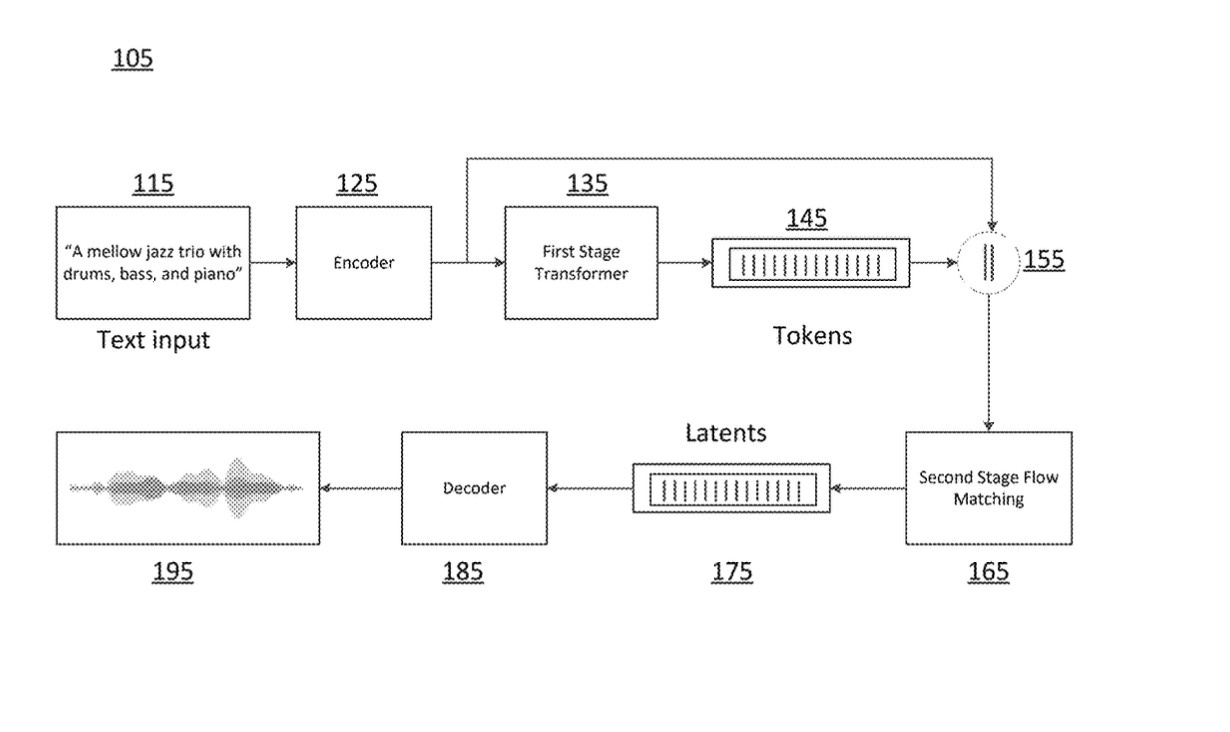
The patented tech first converts user input into a text encoding. It then produces a token representing "coarse" musical information such as rhythm, tempo, or notes.
Meta's filing hints that AI muzak could be a great soundtrack for the Metaverse - a creepy digital corporate hellworld which was all the rage among, well, creepy hellish corporate folks for about five minutes at the beginning of the decade.
The patent describes a two-stage architecture:
- A first-stage transformer (an autoregressive transformer decoder) that output tokens representing broad musical structure.
- A second-stage model using flow matching to add finer acoustic detail - such as timbre or spectral texture - producing dense latent vectors that are then decoded into waveform audio.
Bands on the run?
We are afraid to report that Meta's AI pop bot is far from the only band in town.
Google recently released Lyria RealTime, which allows users to "interactively create, continuously steer, and perform instrumental music. OpenAI also has its own Jukebox, a neural net that generates music including "rudimentary singing" (which Zuck may know a thing or two about already).
All of which leads us to pose the immortal question of the AI age. Yes, we know humans technically can do this. But should we?
Meta's pop music generator may not pose an existential risk to humanity, but it could certainly make life here on Earth that little bit more unbearable.
Which is, after all, what social media giants do best.
Plus ça change, plus c'est la même chose.