NHS warns of “significant” robotics dependency risk as it sets new tech buying rules
Officials fear the UK healthcare system will become addicted to tech supplied by a small number of increasingly powerful dealers.

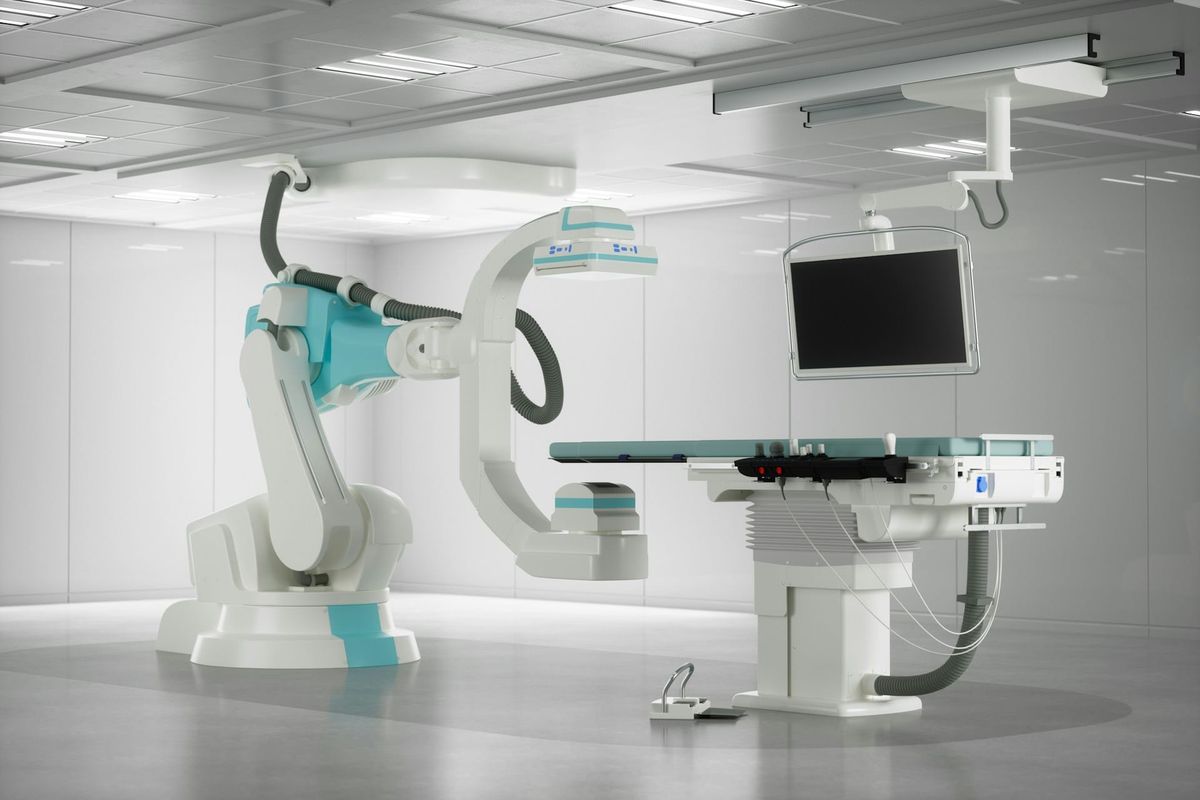
Hospitals could become dangerously dependent on robots, the NHS has warned as it introduced new rules governing a major expansion of the technology.
NHS England said that “significant operational, clinical and commercial dependencies” could emerge as machines take on more roles in the creaking, but often incredible, British healthcare system.
To tackle this systemic risk, officials have set out new procurement rules designed to boost competition.
Hospitals will be expected to competitively procure all new robotic surgery programs and any expansion into new clinical pathways, rather than simply handing the work to an existing supplier.
“Given the long-term nature of robotic-assisted surgery investments and the significant operational, clinical and commercial dependencies that can arise once a platform is established, procurement decisions should promote healthy markets while ensuring the NHS secures value for money and the best possible outcomes for patients,” NHS England said.
Machine dependency in the NHS
It's not hard to see why dependency is a risk to patients. If a robotic device cannot be repaired quickly, for example, surgeries planned using it risk potentially deadly delays.
As an incumbent supplier’s installed base grows, the cost and disruption of replacing it can increase. That can make buying more technology from the same company more attractive, further deepening the dependency.
Ownership and control of vital NHS robotics infrastructure and other critical ystems could also give other, more powerful nations risky leverage over the UK.
NHS England wants to inoculate against dependency by preventing individual suppliers from becoming entrenched.
READ MORE: Superbugs in medical software are driving a healthcare security crisis
As such, hospitals can now only buy more equipment from an incumbent supplier when expanding an existing robotic system within an existing clinical pathway if changing platform would impose a “material cost-of-change.”
An NHS organization can award a contract directly to one supplier on capability grounds only when that company can demonstrably satisfy a specific clinical or operational requirement.
Even then, credible rival suppliers must have an opportunity to demonstrate their capabilities, and the clinical justification must be independently scrutinized.
NHS England said its approach should “strengthen market resilience and supplier diversity” while supporting the growth of robotic surgery.
The NHS robotics revolution
Robotic-assisted surgery is expected to become standard for an expanded range of procedures over the next decade, with adoption increasing from 2026. National robotic surgery data registries and telesurgery networks are planned from 2029.
The government’s 10 Year Health Plan identifies robotics as one of five transformative technologies alongside data, AI, genomics and wearables, promising that “by 2035, robots will deliver care with unprecedented precision.”
The scale of that ambition makes the procurement rules significant. The NHS is attempting to establish competitive safeguards before robotic platforms become deeply embedded across clinical services and expensive or disruptive to replace.
READ MORE: ChatGPT conversations were briefly accessible on Google - including one called "NHS Future Reform Plan"
But the market is already heavily concentrated and the vital signs aren't good.
A 2026 study found 75% of the 212 robotic-assisted surgery systems in use in the UK at the end of 2024 were supplied by one company.
Market dominance means switching suppliers can become difficult without disrupting the services, skills and infrastructure built around technology embedded at the center of life-or-death surgical processes.
The NHS isn't going to start building its own surgical robots. It will depend on private companies for technology that the government expects to become standard across an expanding range of procedures.
That's the dependency NHS England is trying to control.
Lessons from the AI boom
The idea of robots performing surgery can still seem far-fetched and sci-fi. But AI already shows how quickly technology that seems new today can become expected as it embeds across healthcare.
Netskope research found ChatGPT in use at 68% of healthcare organizations it monitored, Microsoft Copilot at 63% and Google Gemini at 57%. AI is also moving beyond browser-based tools into applications connected directly to models through APIs.
That expansion has brought its own risks. Netskope found regulated information accounted for 89% of data policy violations involving generative AI among the healthcare organizations it monitored, compared with 31% globally.
Colette Kitterhing, vice president for the U.K. and Ireland at Netskope, warned that rapidly adopting new technology without addressing the systems underneath it could increase rather than reduce complexity.
“If AI is layered onto fragmented systems, inconsistent access controls and complex cloud environments, it risks adding another layer of difficulty rather than reducing pressure,” Kitterhing said. “For the NHS, the priority should be to build a digital environment where AI can be adopted safely, securely and in a way that genuinely supports care delivery.”
She argued that stopping the transformation while the NHS rebuilds its infrastructure cannot achieve that.
“Care has to continue while transformation happens around it, so security needs to work across that complexity rather than around it.”
Kitterhing said the problem becomes harder as new systems and suppliers accumulate.
“Many NHS organizations are already managing a complex mix of systems and suppliers. Adding more point solutions can make that harder, not easier,” she said.
Protecting critical infrastructure
Her warning is focused on AI and digital infrastructure rather than robotic surgery. But both technologies raise a similar underlying question for a health service adopting systems that could become increasingly important to everyday care: What happens when a useful technology becomes a dependency?
Critical infrastructure becomes more vulnerable when the organizations that depend on technology cannot independently maintain, replace or operate it without the companies that supply it.
When a technology becomes essential, services and skills grow around it. Switching becomes prohibitively disruptive. Dependence on a supplier or platform deepens until a failure in the supporting system can cause the core service built on top of it to fail.
The danger is that robotic technology becomes so deeply embedded that the NHS can no longer realistically replace it, repair it or operate independently.
NHS England's new rules show officials are thinking about that problem before its robot addiction becomes a dangerous dependency.