Shock VoidLink discovery ignites “new era of AI-generated malware” fears
VoidLink appears to have been built by an AI agent and bears the fingerprints of a mysterious Chinese threat actor.


Security researchers have identified one of the first malware strains created entirely by AI, warning that rapid technological progress is making the development of “complex cyber weapons” terrifyingly easy.
Check Point analysed malware called VoidLink and found that it appeared to have been built using an AI agent under the guidance of an individual developer.
Warning that the discovery marks the beginning of a “new era in AI-generated malware”, Check Point said VoidLink displayed “a high level of sophistication” far in excess of the “low-quality or derivative” AI-generated malware identified previously.
Although the cybersecurity firm stopped short of identifying it as Chinese-made malware, it was spun up using TRAE, an Integrated Development Environment (IDE) from China. Instruction documents found on the threat actor’s server were also written in Mandarin.
“AI dramatically accelerated development, enabling what appears to be a single actor to plan, build, and iterate a complex malware framework in days rather than months,” Check Point wrote.
“This marks a turning point: AI is no longer just supporting malware development. It is actively reshaping how advanced threats are created.
“Defenders must adapt, as AI lowers the barrier to high-complexity attacks and increases the speed and scale at which threats emerge.”
Into the void...
On the surface, VoidLink looked as if it had been built by a large organisation. It was sophisticated, modular, and capable of evolving at speed.
The malware used technologies like eBPF, LKM rootkits, and dedicated cloud and container exploitation modules, and was apparently designed and iterated at an unusually fast pace, with a level of sophistication typical of a well-funded cyber operation.
But deeper investigation revealed something more alarming: the framework was likely created by one person using AI not just to write code, but to plan, structure, and execute the entire project.
Operational security failures exposed planning artefacts, source code, and sprint timelines that didn’t match the malware’s rapid real-world evolution.
READ MORE: "Truman Show" scammers are snaring victims in AI-powered simulated realities
Instead, researchers found clear signs that both the development plan and execution had been orchestrated by an AI model, allowing a single individual to drive VoidLink from concept to production at high speed.
“What traditionally required multiple teams working over months was compressed into days,” Check Point continued. “In fact, evidence suggests the malware reached a functional stage in less than a week.
“This highlights a critical shift: AI dramatically lowers the barrier to building complex cyber weapons at the development stage. Skilled individuals no longer need large teams, deep resources, or long development cycles to create advanced threats.”
Bad vibes coding: The creation of VoidLink
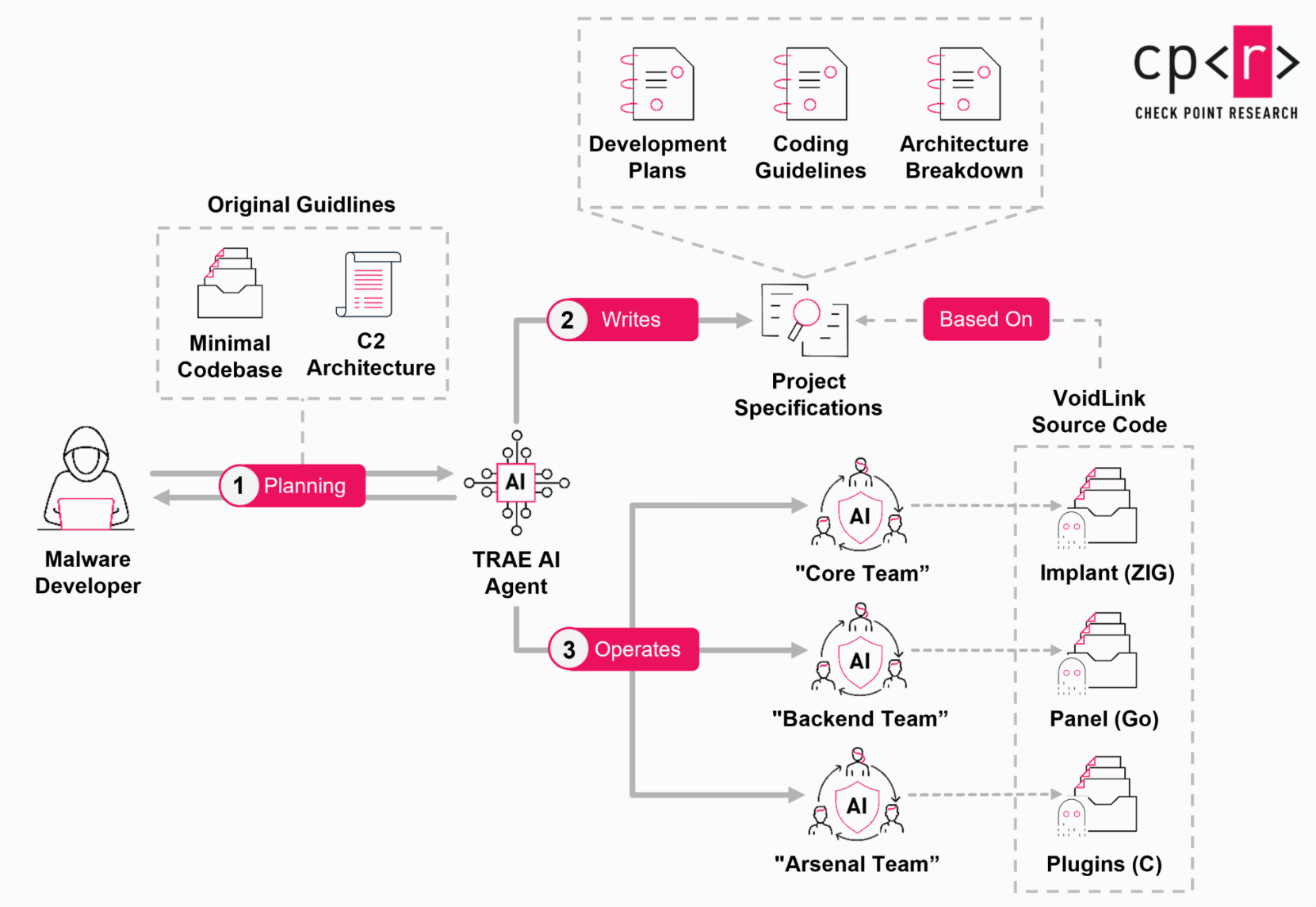
VoidLink was built using a spec-driven development approach: the developer first defined high-level goals and constraints, then asked an AI agent to translate them into an architecture, sprint plan, and task breakdown across three internal “teams” before executing the build.
The threat actor left an open directory exposed on their server, leaking source code, AI-generated planning files, sprint timelines, and TRAE SOLO instruction documents copied straight from the development environment.
These opsec failures gave researchers “unusual visibility” into VoidLink’s internal blueprints and revealed how a single individual used AI to plan, build, and accelerate the malware.
READ MORE: Russian hacktivists blitz UK critical infrastructure and local government targets
Helper files generated by the TRAE SOLO AI assistant — including a Chinese-language instruction document laying out baseline requirements — revealed how the malware’s structure, coding standards, and development plan were all orchestrated by AI from the very start.
Check Point's research is significant because it indicates that life is becoming easier for threat actors as AI lowers the barrier to entry.
In the future, it is easy to imagine relatively low-skilled hackers causing serious damage with malware spawned using AI.
Not the end of the world... yet
However, VoidLink is not an apocalyptic development in malware. The true nightmare scenario would be malware devised and created by a machine — a prospect that seems inevitable if the fast-paced evolution of AI continues.
The actor involved in its coding was also described as “capable” — a word that should reassure every defender.
“VoidLink represents more than a single malware discovery — it signals a broader shift in the threat landscape,” Check Point said. “AI-generated malware development is no longer speculative. It is here, and it is evolving fast.”
READ MORE: Cyberattacks can spark cascading social crises that "engulf communities"
While VoidLink is among the first pieces of AI malware, it is not the last. In fact, it may be one of many strains already in circulation.
Check Point warned: "Our investigation into VoidLink leaves many open questions, one of them deeply unsettling. We only uncovered its true development story because we had a rare glimpse into the developer’s environment — a visibility we almost never get.
"Which begs the question: how many other sophisticated malware frameworks out there were built using AI, but left no artefacts to tell?"