“We’re expanding in one area”: Salesforce reveals the only department still hiring humans
Want a job at Salesforce? Then you'd better start sharpening up those non-automatable people skills...

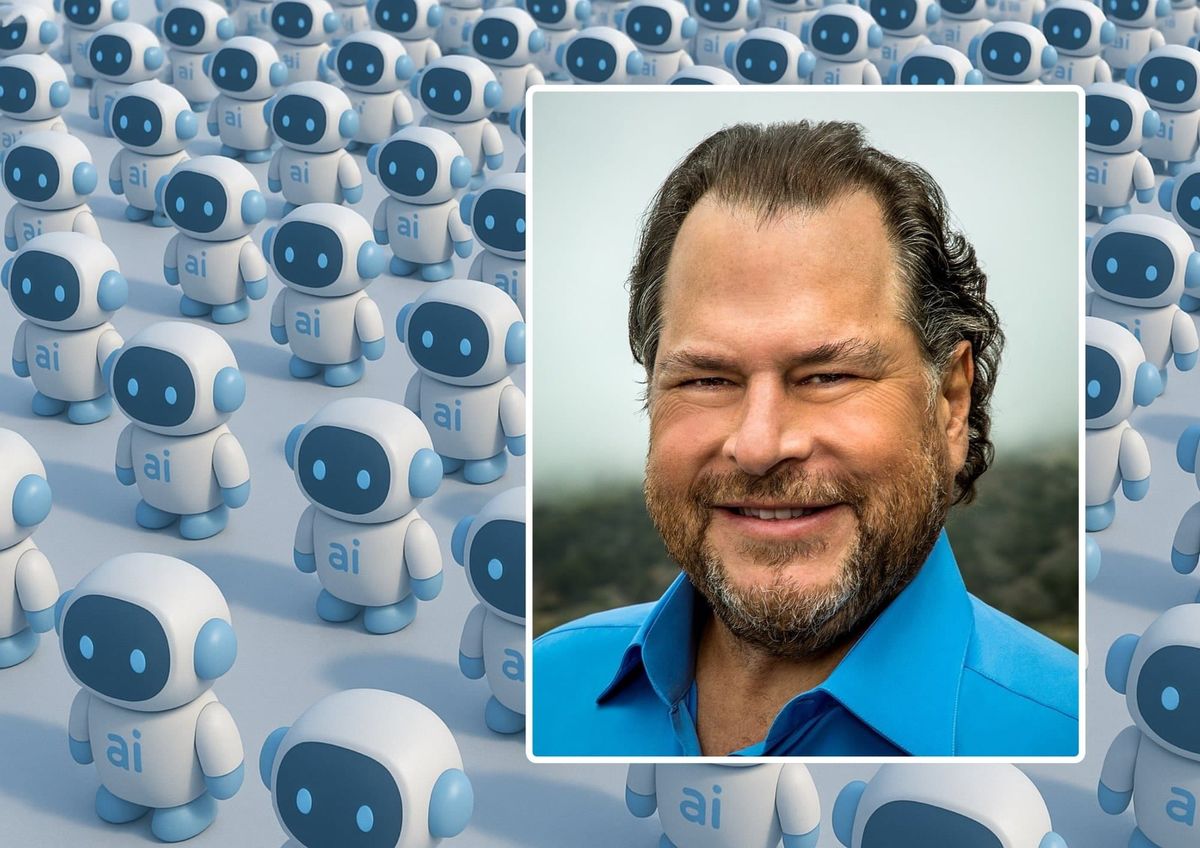
Salesforce boss Marc Benioff has been outspoken in his support for using machines to do the jobs which once required humans.
Last year, the billionaire famously said the progress of AI was "pretty awesome" as he announced plans to hire precisely zero engineers - before backtracking a little and slamming "alarmist" jobs fears.
Now the Salesforce supremo has confirmed that hiring of human engineers has indeed been "mostly flat" recently and shared the one area where legacy lifeforms are still being hired: sales.
In an earnings call, Benioff revealed that Salesforce employs about 15,000 engineers - a figure that has remained static for the past two years.
"I would say that the reason it's been mostly flat is because we have been using AI to create more efficiency for our engineers," he said. "Especially this year now with these new coding agents, we're seeing even more dramatic capabilities."
The agentic enterprise overlord said that a "key part of the margin story" - corporate jargon for the tale of how Salesforce is boosting profits- is that engineers and general administrative staff are just not getting jobs at the rate they once were.
Hire a human
But there are still jobs in business that no machine can do alone - although they can certainly help.
Benioff added: "We're mostly expanding only in one area. You can see headcount has grown, but it's mostly growing in... sales."
Why?
"Because I think we all realise that selling and communicating, the agents are not exactly doing that."
In other words, agents can test out leads and process support requests. Closing deals still appears to require actual humans.
Salesforce's army of agents has now handled more than 4 million autonomous "service transactions" in customer support functions - twice as many as human agents.
This means that bots work on the front line to process the initial stages of inquiries and pass customers to real human staff when they encounter a "computer says no" moment.
AI has also qualified "huge numbers" of leads, screening potential customers before a real salesperson contacts them.
"Humans and agents collaborate across every channel, from first contact to first resolution, across the trinity of channels, voice, website, apps," Benioff said.
The rise of hybrid workplaces
This division of labour between humans and machines is likely to become a familiar pattern across all areas of the economy.
A recent Boston Consulting Group report predicted that even though more than half of jobs will be significantly reshaped by AI over the next two to three years, only 10% to 15% are likely to be fully replaced. People who survive this shift will be needed in areas requiring judgment, trust and the development of customer relationships.
"When the productivity gains from AI use trigger increased end product demand and the potential for augmentation is high, we believe there will be a need for more and, in some cases, new human roles," the paper's eight human authors wrote.
Last year, a paper from MIT Sloan School of Management found that the doomsday scenario of robots completely replacing old-school homo sapiens in the workplace is likely to be overblown.
READ MORE: “I need less heads”: Salesforce boss Marc Benioff takes (metaphorial) axe to human support workforce
Instead, people and computers will collaborate to achieve new levels of productivity.
“There tends to be a prevailing narrative that robots are coming for jobs,” said Rigobon, Professor of Management at MIT Sloan, who wrote the paper along with postdoctoral associate Isabella Loaiza.
“We think it’s important to ask different questions - looking more at human capabilities than AI capabilities and shifting toward what technology can give us rather than what it might take away.”
The academics set out five areas in which humans are likely to retain an edge against our new digital competitors:
- Empathy and emotional intelligence
- Presence, networking and connectedness
- Opinion, judgment and ethics
- Creativity and imagination
- Hope, vision and leadership.
Another point to consider: who's going to take the blame when something goes wrong?
Try dragging an algorithm into a parliamentary inquiry and you'll quickly answer that question.
Please get in touch if you've been impacted by AI in the workplace.